For Ma Rainey’s Black Bottom, Colman Domingo Looks to a Century of Code-Switching
Both Colman Domingo and this interviewer are guilty of referring to Ma Rainey’s Black Bottom as a play when talking about the new Netflix film. It’s an easy mistake, given the source material from playwright August Wilson and the theatrical aesthetic of director George C. Wolfe.
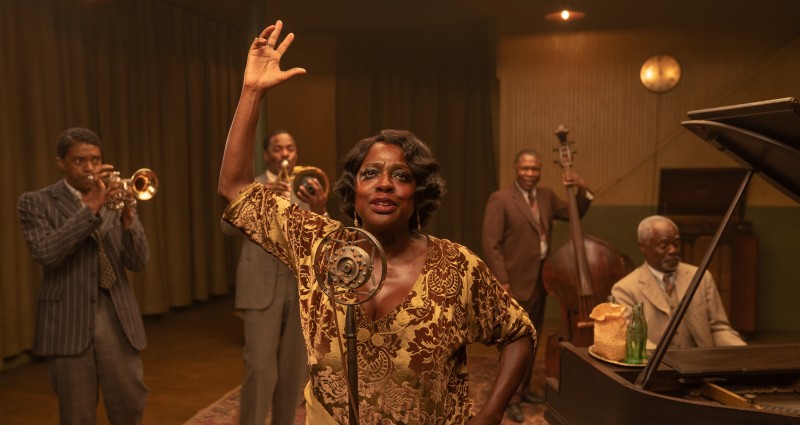
Domingo, a Tony nominee for The Scottsboro Boys and a playwright himself, takes on the role of saxophonist Cutler in the screen adaptation. Like the play, the movie explores the exploitation and commoditization of Black artists through the lens of a recording session with blues legend Ma Rainey (played by Tony and Oscar-winning Wilson interpreter Viola Davis). As band leader, Cutler navigates that as both a Black performer and a proxy for white gatekeepers—territory all too familiar to Domingo.
In the interview below, the actor discusses drawing on his musical and theatre roots, the responsibility of a band leader, and a century of code-switching.
What influence has August Wilson’s body of work had on you as both a playwright and performer?
Everything. I didn’t realize how much August Wilson has affected my work as a playwright. I wrote my play Dot before I directed Seven Guitars, but there are a lot of similarities. Mine is a Philadelphia story about a family, and there are seven members of the company. Seven Guitars is seven members of the company, set in Pittsburgh. I realized our shared experience when it comes to all these Southerners from the Great Migration living in northern cities and all the things they’re seeking. All the conversations they’re having seem very similar. I was tapped into something I didn’t know I was already tapped into. It’s something August Wilson has laid bare in his Century Cycle, which is incredible. I think that’s why every African-American actor would love to be able to do an August Wilson. You feel like you’re close to your family; you’re closer to yourself. You don’t have to go so far outside of yourself to do the research and detail the work. All you have to do is go into your family photos, your stories, your history of migration. My mother’s side of the family came from Alabama and Georgia, and I have a lot to mine from there. That’s why I was able to go there as Cutler, knowing where he was from in Georgia. I have a lineage to that and to that experience. It’s a tremendous honor to do an August Wilson work, and I know he’s had a profound impact on me because I know I like to tell stories that are complex about African-American life. It’s the idea that they don’t have to be heroes; they’re ordinary people in extraordinary circumstances.

The idea of African-American artists having that shared complex history to draw on reminds me of the essay you wrote back in June, where you said these injustices have always been present, but now we have cell phones and the technology to capture them. And at times it does feel like this movie is using that cell phone to capture something we’re still talking about, the commoditization of Black artists, taking place 100 years ago.
This film feels like it’s a part of that. It’s a cinematic telling of a legendary blues singer who, even in 1927, was fighting the same battles we’re fighting right now. She’s asking to be seen as human and saying, “If you want my talent, have all of me.” You have to take all of me. You can’t just have the talent and discard the rest, which is something I know I feel as an artist. I’ll say this, since this is Playbill. I have been part of We See You White American Theatre and making sure we’re moving the dial when it comes to diversity, equity, and inclusional practices. This is the time to deconstruct these racist institutions—on the corporate level, in theatre, in music, wherever you are; it’s time to take a sledgehammer to all of it. African-Americans, we do know our contribution to the country, but do we get paid our worth? Do we get the respect? Do we have the longevity? The same access as our white counterparts? I think an examination in a film like this around a formidable force like Ma Rainey is truly exceptional to have this year to look at. All summer, I’ve been engaging with conversations of, “What can I read? What work can I do to know more?” Because surprisingly, my white counterparts didn’t know there was a systemic problem. I feel like this is yet another tool. Examine everything. Read everything. August Wilson is your playwright as well. I read O’Neill, I read Pinter, I read Shakespeare. You read August Wilson as well. You read Robert O’Hara. You read Jeremy O. Harris. Those are your playwrights as well. Why? Because they’re American writers. We should know each other’s history.
Do you feel those types of conversations informed your portrayal of Cutler?
Oh, yes. Cutler is the bandleader. He’s Ma’s proxy when she’s not in the room. He’s also a member of the band. I have always been the leader of any acting company. “Who’s the Equity deputy?” It’s me. So it makes sense that I was cast in this role in this film. He does feel like he’s code-switching and navigating many systems. I think Ma respects that he’s up to the task. Because it’s a very large task. But it has to be done with grace, and with a sense of humor and a sense of compassion. I think I’m able to navigate that with Cutler in this film because he’s the only one who navigates all the different worlds. He’s able to have access and have audience with Ma alone. He’s also the first person the white institutions see. They deal with Cutler.
How does that code-switching manifest in Cutler?
I wanted to make sure that the subtle code-switching was just ingrained in him because of the systems in the world. My 6’2″ body frame probably gets a little smaller and hunched when speaking to Mr. Irvine. It’s something he’s not even conscious of. I think that’s a great exploration for white folks to see. Black folks do this all day long. It’s something that’s been codified in our spirit. It’s interesting to see how much more work we have to do just to have a complex, strong existence.
Was that something important for you to explore with [director] George C. Wolfe?
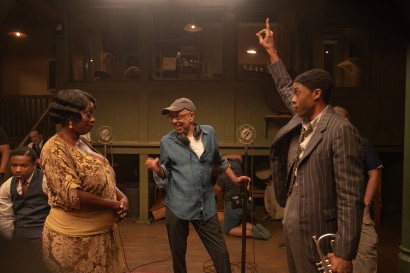
Yes. The beautiful thing about George is you sit with him and you dissect your character and talk about what makes him tick. You build it from the inside out and the outside in. I did the work of finding out what his spiritual core is and what was his operating system, which is in direct conflict with Levee. When I first showed up, George said, “How old are you?” I said I’m 50. He’s like, “You look too young. You gotta look older.” So I know what to do; I’m a character actor. I can change my body, I can change my face and the way I carry myself and my voice. That’s the joy of working with George and doing an August Wilson play. You want to bring a fullness to a character. Colman falls away, but also Colman is underneath every part of it at the same time.
READ: The Oral History of The Scottsboro Boys
Playbill talked to you recently for the anniversary of The Scottsboro Boys. I’m thinking about some of the plays you’ve written, including the book to Summer [the Donna Summer bio-musical] and [the Nat King Cole-focused] Lights Out. And now we’re talking about Ma Rainey. Do you see music as a throughline in the stories you tell?
It’s wild. I didn’t realize that. People know that I’m a musician. I don’t play the trombone, but I was willing to learn and make it appear that I play very well. It was a part of having an appreciation of musicianship, the way music tells a story. I guess that’s why it makes sense to me, the idea of being the bandleader. I don’t know why, but it does.
What did being that bandleader figure off-screen entail?
The first thing I did as a bandleader was organize a dinner. We’re all workhorses, so everyone was working then going home and doing the work at home. And I was like, “We need to have dinner. Let’s have dinner together this weekend.” So I found a really nice restaurant and I made sure it was just myself, Michael, Glynn, Chadwick, and Viola. And I knew that was a strong part of it. As you know, I come from the theatre, and you go to the pub, you have a drink, you have a meal, that’s the way you get to know one another. That’s where trust is established, because you get to know a person’s heart, their soul, their insecurities. You know how to hold space for them eventually. That’s what I knew was part of my job.
And what did you find was the way to hold space for them?
I needed to make sure the room was malleable, gracious. The beautiful thing is [producer] Denzel [Washington] made me the custodian of [Unity’s] Daily Word, where I would read some text every day to my men in the band, and we would talk about it. Daily Word is spiritual, but also just some food for thought about how to be in the world. Denzel is very much a man of faith, and he wants to make sure that we have a spiritual core that will allow us to go to these places we need to go through in the film. So I would sit there every day and I would read to these men and we’d think about it, so we were almost having our own prayer circle in a way. It’s the same thing I had with The Scottsboro Boys. I was always giving words and testimony. I’m a spiritual guy. I’m not religious, but I come from a long line of preachers, and I realize in my life that my preaching is through acting and writing and directing. So, I’m always willing to take on that role, who needs to help guide the soul of an experience. I’ll do it.
A First Look at Ma Rainey’s Black Bottom Starring Viola Davis and Chadwick Boseman