Theatre fans need not travel all the way to New York City to get a taste of Broadway. Though the Big Apple boasts perhaps the freshest productions and greatest talents in the world, many of the most successful shows on Broadway will eventually hit the road- bringing and equally magical though sometimes slightly updated version of their production to cities across the country.
In recent years, the theatre industry has prioritized sustainability—whether that’s through SCENERY’s upcycling of show curtains into handbags and show deck into jewelry, or the Broadway Green Alliance’s e-waste collections and textile drives. But TDF (the organization that brings you TKTS and so much more) has been way ahead of the curve thanks to its Costume Collection, which opened in 1974.
Now housed at Kaufman-Astoria Studios in Queens, New York, the TDF Costume Collection Rental Program is a stories-high warehouse full of costume donations from Broadway productions, touring companies, regional houses, and more, that rents out its 85,000-piece inventory to any organization working in theatre, film, dance, TV (or other artistic endeavor) at any level. Everyone from Saturday Night Live to a high school in Kentucky rents from the massive collection. Thanks to their work, approximately 44,000 pounds of materials were saved from landfills last year alone—not to mention the fabulously dressed productions that resulted.
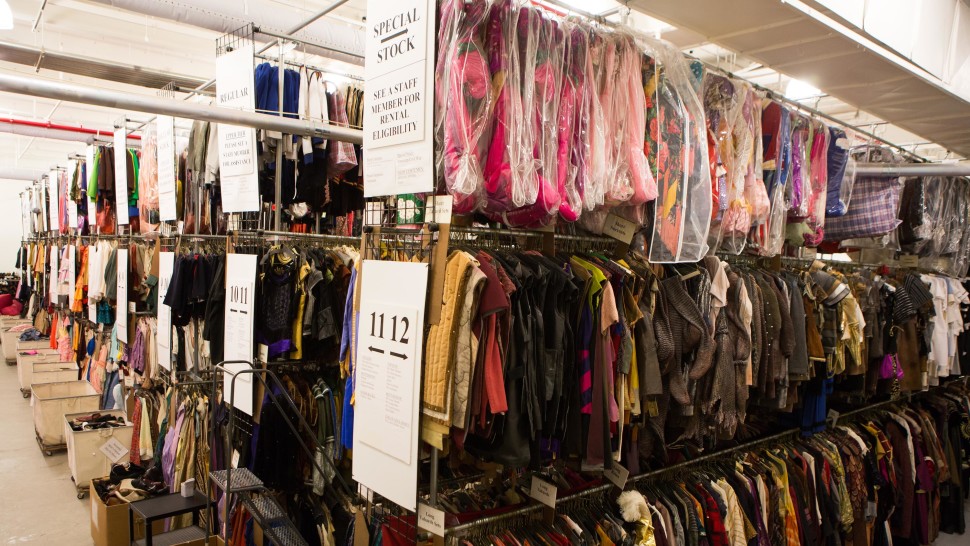
Racks upon racks of clothing fill the massive warehouse, with some aisles stacked four racks high. Divided first by time period, then by article of clothing, and often by color, the TDF Costume Collection boasts pieces from the Bernadette PetersGypsy, Bob Mackie’s studio, the Metropolitan Opera, Jelly’s Last Jam, The Boy From Oz, Orange Is the New Black, The Little Mermaid, and hundreds more.
TDF Costume Collection Special Stock Courtesy of TDF
“We have a number of wardrobe people on Broadway and a number of producers who think of us all the time,” says Stephen Cabral, a full-time staffer since 1994 and the director of the Costume Collection since 2008. “When the show’s in previews [and costume changes happen] or when a show closes, certain producers give us pieces or all of the show’s costumes.”
The Collection clothes approximately 1,000 productions per year, renting about 10,000 costumes across 38 states. TDF’s Collection also serves as a living archive of costume design; Cabral displays the most singular pieces—like an original Elphaba Act 2 gown from Wicked and Pearl Bailey’s Hello, Dolly! dress—in the Collection’s Education and Research Center. Akin to a TDF museum, the Collection is an evolving record of design.
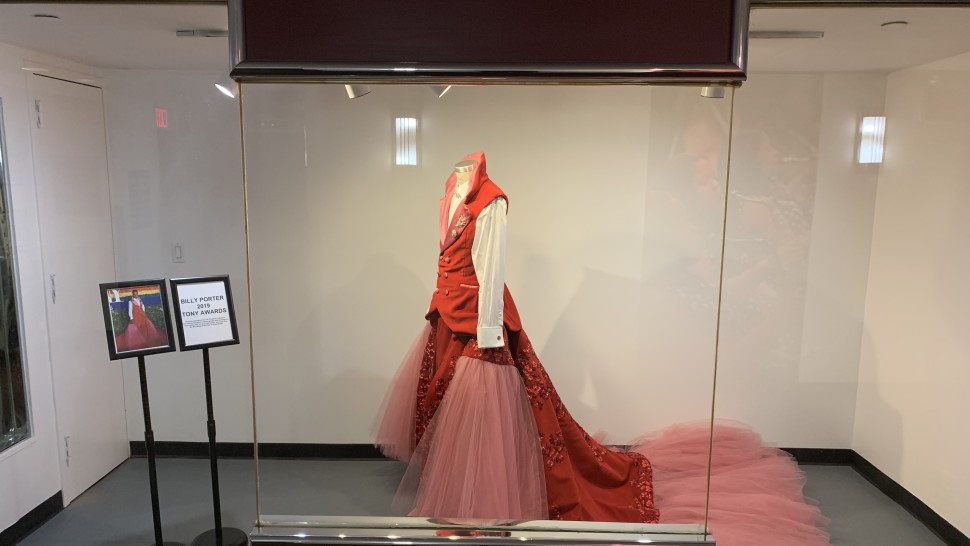
Billy Porter’s upcycled Celestino Couture gown for the 2019 Tony Awards Courtesy of TDF
What You Can Rent Cabral and his staff separate the Collection into regular stock and special stock; the latter includes high-end items like an original gown from Anastasia, Renaissance garb from Something Rotten! on Broadway, and the clothes from the 2016 She Loves Me revival. Still, clients typically frequent regular stock. “Our two biggest sections that get rented all the time are 18th century—so anything that looks like Marie Antoinette—or generic 19th century—so it would work for The Importance of Being Earnest or it might work for The Cherry Orchard,” says Cabral.
But clothing from every period and aesthetic stuffs the racks in Queens. Mamma Mia! disco jumpsuits? Check. The Little Mermaid spandex? Check. Leopard print jackets, luxurious furs, hand-beaded flapper dresses? Check, check, check.
From extravagant to practical, the Collection can be a resource for many productions—but not all. “We’re dependent on donations not only to keep stock [generally] full, but also to do certain shows,” says Cabral. “Up until maybe 10 years ago, we couldn’t really do Gypsy. We didn’t have the cow; we didn’t have the strippers.” And then, the dry cleaner for Bernadette Peters’ Gypsy didn’t want to store the archive anymore and, soon after, Mackie donated his made-for-TV repertoire. Suddenly, Gypsy was on the menu.
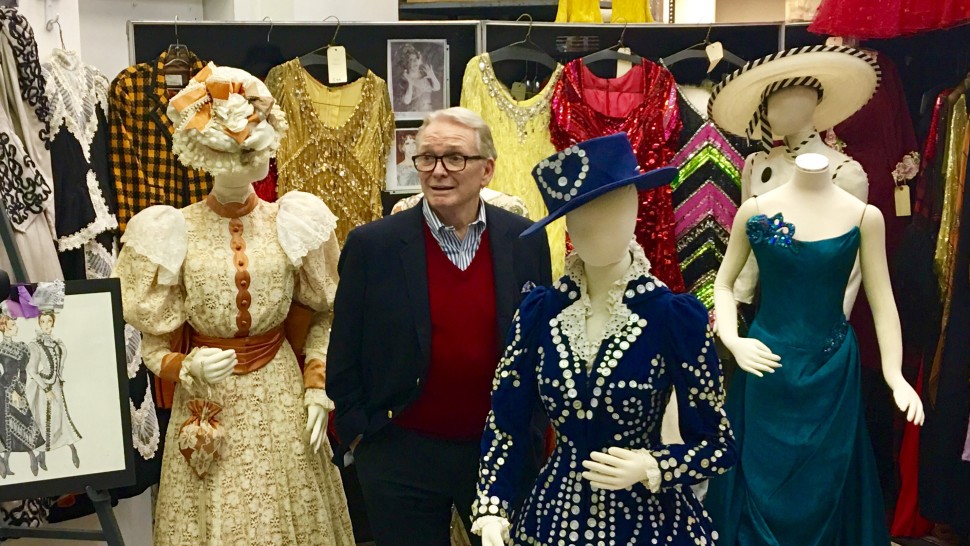
Bob Mackie with some of the costumes he donated to TDF Courtesy of TDF
How to Rent Many people can rent from the Collection in person or by mail order. Rental fees are “per costume,” which is one head-to-toe look—and customers get creative. If you dress one person with a hat, gloves, shoes, a top, a jacket, and a skirt, “we don’t go to the theatre to check to make sure one actor is wearing all of that,” says Cabral. “Maybe I’m wearing the jacket and skirt in one scene and someone else is wearing the hat, the gloves, and the shoes.”
A full regular-stock costume costs $130 for a one-week rental, but non-profit rates (which may cover public schools, colleges, universities, non-profit private schools, religious groups, etc.) begin at $50 for a one-week rental, plus a dry cleaning fee. Rental rates depend on: non-profit status, length of the rental, and audience capacity. (More pricing info here.)
But the expertise TDF offers is invaluable. “A lot of people walk in here without a costume degree, so they’re going to ask for what they think [the period] is and we interpret,” says Cabral. “They would probably say, ‘I’m looking for Victorian,’ and they have an idea in their head of what that looks like. To me, Victorian makes no sense because Queen Victoria reigned for 60 years and fashion changed so much—but it’s all in our aisles.”
Anyone can make an appointment to visit the Collection, explore the racks, and rent on site. Be sure to bring your actors or their full measurements. “People are expecting it to be like a department store where everything is going to be tagged [with its size],” says Cabral, but that’s not the case. You can try things on a dress form, or there are two fitting rooms for actors that must be booked in advance.
Even with full measurements, TDF recognizes costumes may not fit perfectly and exchanges are always possible. Minor alterations are acceptable, but there is no gluing, cutting, painting, dying, or use of stage blood on any costumes.
For those less experienced in costume design, a staff designer can help pull costumes for a minimal additional fee. Think of it as the Collection’s version of personal shopping.
Though not everyone can make it to Queens, TDF will not allow that to deter renters. Last year, 15 percent of rentals filed via mail order. In this case, clients either submit “your design” by completing a costume plot form to demonstrate the vision, or elect “our design” where the staff chooses the best looks for the title. Mail orders incur labor fees: 25 percent of the total rental for “your design” and 30 percent of the total rental for “our design.” But for educational programs and theatre across the country, the professional touch is worth it.
TDF Costume Collection racks Courtesy of TDF
How to Buy Twice a year, the Collection hosts a “Bag Sale” in which customers can RSVP, walk in, choose a $20-size bag or a $50-size bag, and fill it up with as many clearance items as they can. These are items in the Collection that have become too worn or distressed to rent, or if no one has rented them in a long time or are donated pieces that don’t fit into the selection.
“For us, it’s a way of getting rid of things; we’re not going to throw them in the landfill, we’re green,” says Cabral. “For some of these people, this is how they are able to produce theatre.”
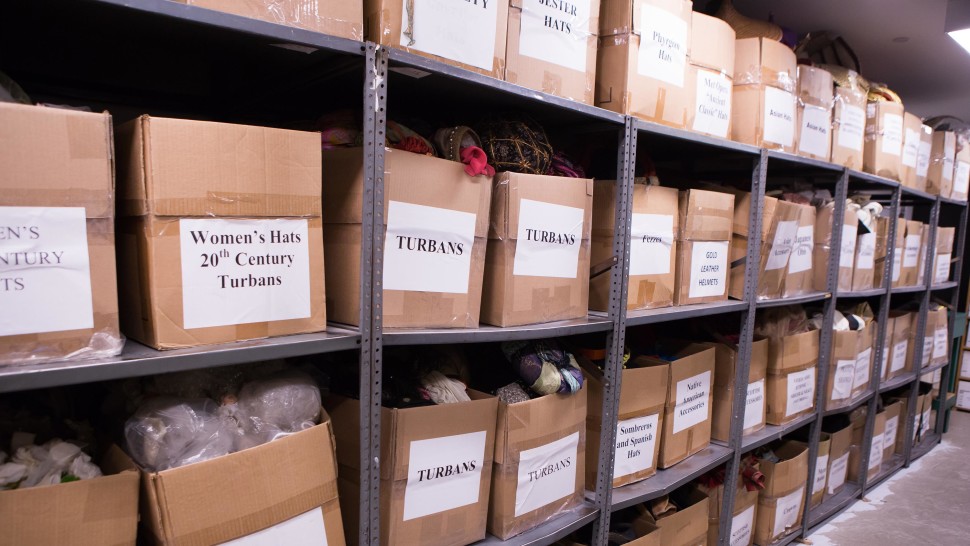
TDF Costume Collection accessories Courtesy of TDF
Custom Costumes TDF’s Collection is an unparalleled operation—the only of its kind. Its success depends on the niche knowledge Cabral and the expert staff in the warehouse possess.
“Nothing here is in a catalog,” he says. “You really have to have a good sense of fashion or costume history because you really need to be able to look at something and go, ‘That’s 1860s, that’s 1910,’ because that’s how it goes back into stock.”
Just as Broadway costume designers tell stories and build characters through clothing, so too does the TDF staff—but with the added challenge of relying solely on their stock. Their work makes authentic theatre, film, and television possible at every level of performance.
“We’re a cross between a car rental dealership and a library,” Cabral compares, “while also being this repository for the history of costume design and, sometimes, the history of Broadway.” It’s a tall order, but luckily they have the space to handle it.
For more information about the Costume Collection, to make an appointment, or to place an order, click here.
If the open hardcover copy of Thomas A. Harris, M.D.’s 1967 self-help bible ‘I’m OK - You’re OK’ casually placed upon an ottoman makes you chuckle a bit as you settle down for The New Group’s latest endeavor, you’re of a proper mindset to enjoy Duncan Sheik musiclyrics, Amanda Green lyrics and Jonathan Marc Sherman’s sweet, funny and endearing new easy chamber musical BOB CAROL TED ALICE.
Some folks dream of the wonders they’ll do, but in the latest episode of Playbill—The Game Show with contestants Alyssa Giannetti, Bronson Norris Murphy and Rema Webb from the cast of Paper Mill Playhouse’s Unmasked: The Music of Andrew Lloyd Webber actually do them. Watch the video above.
Join guest host Laura Osnes as we test your knowledge of Andrew Lloyd Webber and Paper Mill Playhouse.
The Paper Mill Playhouse’s world premiere of the retrospective Unmasked: The Music of Andrew Lloyd Webber began performances January 30 prior to its official opening February 9 at the New Jersey venue.
With music by Lloyd Webber and co-written and devised by Richard Curtis, the limited engagement will continue through March 1.
JoAnn M. Hunter (School of Rock) directs and choreographs, with music direction by Michael Patrick Walker (Avenue Q). The cast features Nicholas Edwards (Frozen), Alex Finke (Come From Away), Giannetti (Love Never Dies), Kara Haller (School of Rock), Jeremy Landon Hays (The Phantom of the Opera), Amy Justman (Company), Andrew Kober (School of Rock), Angel Lozada (NBC’s Jesus Christ Superstar), Mauricio Martinez (On Your Feet!), Murphy (Love Never Dies), Mamie Parris (School of Rock, Cats), Dave Schoonover (Love Never Dies), and Webb (Escape to Margaritaville).
The musical portrait offers an intimate look at Lloyd Webber’s five decades in the spotlight and beyond, from his quirky family and bohemian youth in London to the creation of Jesus Christ Superstar, Evita, Cats, The Phantom of the Opera, and Sunset Boulevard. Audiences can expect some new interpretations of his best-known songs, rediscovered tunes, and material specially written for this production.
BroadwayWorld has just learned that Chad Burris will step into the role of Damian Hubbard in Mean Girls on Broadway, beginning March 10. Burris, who currently stars as Olaf in Frozen, takes over for Tony nominee Grey Henson, who plays his final performance on March 8.
The New Group celebrated the official opening of the world premiere of Bob & Carol & Ted & Alice at The Pershing Square Signature Center February 4. The musical, based on the 1969 film by Paul Mazursky and Larry Tucker, follows two couples whose outlooks on life are changed by the sexual revolution.
Bob & Carol & Ted & Alice, which began January 16, features music and lyrics by Duncan Sheik, lyrics by Amanda Green, and a book by Jonathan Marc Sherman.
Directed by Scott Elliott with musical staging by Kelly Devine, the world premiere features a cast made up of Jennifer Damiano as Carol, Ana Nogueira as Alice, Joél Pérez as Bob, and Michael Zegen as Ted.
Jamie Mohamdein and Suzanne Vega round out the cast as ensemble member and the band leader, respectively.
A Look Inside Opening Night of Bob & Carol & Ted & Alice
The world premiere features scenic design by Derek McLane, costume design by Jeff Mahshie, lighting design by Jeff Croiter and sound design by Jessica Paz. Orchestrations are by Duncan Sheik, and music supervision, vocal arrangements and additional orchestrations are by Jason Hart. Antoine Silverman is the music coordinator, Jill Mazursky is the consultant, and Valerie A. Peterson is the production stage manager. Casting is by Telsey + Company, Rachel Hoffman CSA.