World-renowned soprano Renée Fleming, who made her Broadway bow in Joe DiPietro’s Living on Love, is currently making her Broadway musical theatre debut in the critically acclaimed revival of Rodgers and Hammerstein’s Carousel, which was recently nominated for 11 Tony Awards, including Best Revival of a Musical. Fleming, a recipient of the National Medal of Arts, also earned a Tony nomination for Best Performance by an Actress in a Featured Role in a Musical for her work as Nettie Fowler, a part that allows the multiple Grammy winner to wrap her rich, golden, soaring tones around two R&H gems: the rousing “June Is Bustin’ Out All Over” and the anthemic “You’ll Never Walk Alone.”
We recently asked the acclaimed artist to pen a list of her most memorable nights as a performer; her responses follow.
“The Star-Spangled Banner” at Super Bowl XLVIII
Singing in a stadium for an audience of more than 111 million viewers (the largest in U.S. television history at the time) was thrilling. The roar from the crowd at the climax of the anthem is something I’ll never forget, and having fireworks and a flyover of Blackhawk helicopters on the last note was just overwhelming. I had walked carefully onto the 50 yard line in five-inch platform heels, but I floated off.
Metropolitan Opera debut
Renée Fleming in The Marriage of FigaroWinnie Klotz / Met Archives
My Met debut, as the Countess in Mozart’s The Marriage of Figaro, happened with a few hours notice. I was the cover (opera’s answer to Broadway’s understudy) for an ailing soprano. I walked onstage to see a cast of artists who I had idolized, but never met. It was breathtaking to see them in such close proximity for the first time, while simultaneously making an important debut.
Paris Opera My debut at the Opera Bastille in Paris was also in The Marriage of Figaro, but it was memorable in a completely different way. It was the eve of the Gulf War. Protesters broke into the theatre in the first act, and actually took over the stage, chanting, “France out of the Gulf.” I was watching all of this on the monitor from my dressing room. Amazingly, the performance continued, with the impresario trying to calm the demonstrators, while the singers kept singing and the orchestra kept playing. Then the police arrived in full riot gear. When I entered to sing “Porgi, amor,” one of the hardest arias in the opera, with traces of tear gas still hanging in the air, my tears were real.
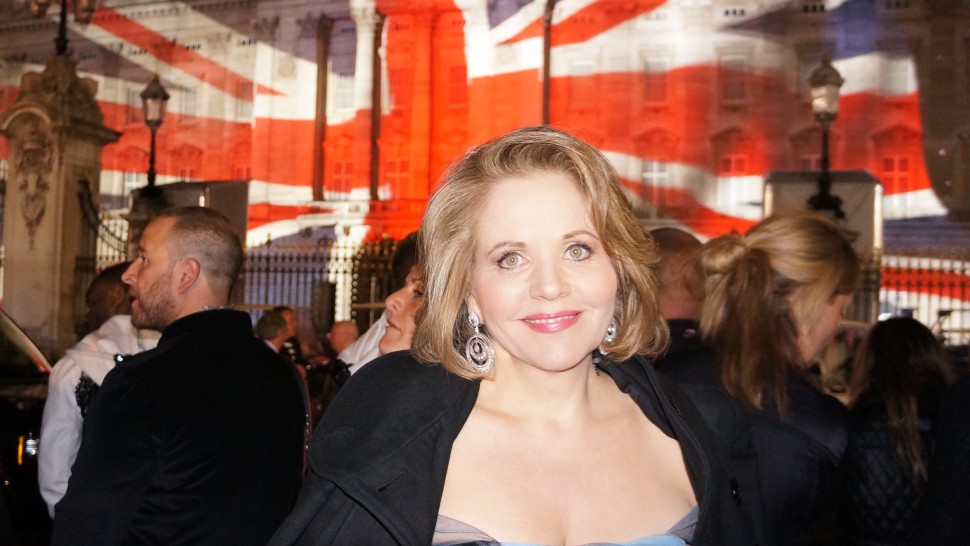
Buckingham Palace
Backstage from Buckingham Palace for the Queen’s Diamond Jubilee Renée Fleming
For the televised Diamond Jubilee Concert for HM Queen Elizabeth II, I sang on the balcony of Buckingham Palace with the English tenor Alfie Boe. We were the first non-royals ever to step foot onto this balcony. Everything about that was memorable: borrowing Katie Couric’s stylist for a last-minute hair emergency, being escorted through the Palace, and meeting the Queen with the other artists.
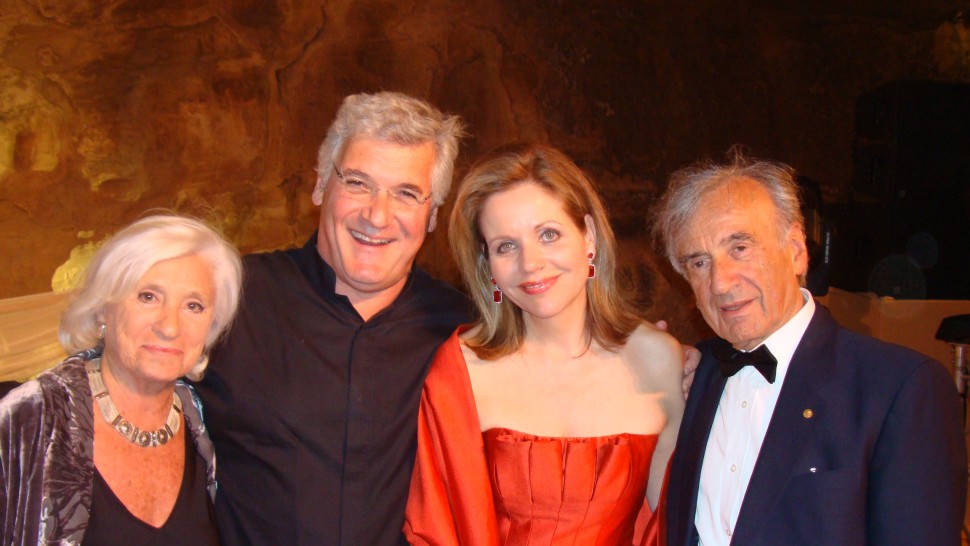
Petra Nobel Gathering
Marion Wiesel, Pinchas Zukerman, Renée Fleming, and Elie Wiesel Renée Fleming
Singing for a conclave of Nobel Laureates in the ancient Jordanian city of Petra was an experience unlike any other. Petra is a UNESCO World Heritage Site, with monumental temples, tombs, and an amphitheatre carved out of the rose-colored rock faces of the mountains. It was almost surreal to walk by candlelight into the site, on Persian carpets laid over the sand, and sing surrounded by all of that natural and man-made beauty, for a gathering that included Elie Wiesel and dozens of other Nobel Laureates and world leaders.
We Are One: The Inaugural Celebration at the Lincoln Memorial
It was a truly unforgettable honor to perform in the concert for President Barack Obama’s inauguration in 2009. In front of the Lincoln Memorial, I sang “You’ll Never Walk Alone” (which I do every night now on Broadway in Carousel) with the U.S. Naval Academy Glee Club. Singing Rodgers and Hammerstein’s glorious anthem for a live audience of 400,000 in the bitter cold of January, plus a television audience around the world, I was part of an historic, unifying moment in American history unlike any I had ever witnessed.
First Look at Jessie Mueller and Joshua Henry in Carousel on Broadway
In celebration of the centennial of the birth of Jerome Robbins, whose contributions to the worlds of ballet and Broadway musical theater have made an indelible impression on both art forms, New York City Ballet will open a festival dedicated to Robbins on May 3. Robbins 100 will feature 20 works created by Robbins, NYCB’s co-founding choreographer, as well as two world premieres: Something to Dance About, by Tony Award-winning choreographer and director Warren Carlyle in tribute to Robbins’ legendary Broadway career, and a second world premiere by NYCB Resident Choreographer Justin Peck set to Leonard Bernstein’s Prelude, Fugue and Riffs, in honor of the centennial of both Robbins and Bernstein. The choreographer and composer collaborated on several landmark works for ballet and Broadway, including Fancy Free, West Side Story, and Dybbuk. A version of the following article originally appeared in NYCB’s Playbill in the Spring of 2008.
Two ambitious, formidably talented men—one barely 25, the other 24—met for the first time in the summer of 1943. Lenny Bernstein was on the brink of sudden fame: the moment when he would step in to conduct the New York Philharmonic on a day’s notice. Jerry Robbins, only a couple of months younger, had been told, finally, that he could choreograph a work for Ballet Theatre, the company that employed him as a principal dancer. Bernstein had been suggested to Robbins as just the person to write the kind of bumptious, jazz-tinged music that would suit Robbins’s scenario about three sailors on shore leave in New York City and the girls for whose attentions they competed.
Bernstein and Robbins (seated) with Sol Hurok on the set of Fancy FreePhoto courtesy New York Public Library
Fancy Free was the beginning of a long, contentious friendship and three no-less-contentious collaborative ventures for Leonard Bernstein and Jerome Robbins, but between November 1943 and April 18, 1944, when this very timely, very American ballet brought a New York audience to its feet, both were exuberant about working together. Robbins was on tour with Ballet Theatre, playing mostly one-night stands; Bernstein, suddenly famous, was conducting orchestras around the country. They communicated mainly via letters, and Bernstein not only sent Robbins the score as it emerged, but 78 RPM phonograph records featuring two-piano versions of the music, played by himself and his good friend Aaron Copland. The young collaborators were certainly on each other’s wavelength, although perhaps only their relative inexperience explains why Bernstein so willingly accepted Robbins’s suggestions about the music, responding to one complaint: “About the ending of #2: Throw it out. It’s not necessary, and I see your point.”
What emerged from this long-distance creative process is a ballet score miraculously in tune with the steps it accompanied. Bernstein not only wrote brilliant, nervy dance passages—trolling the blues, hot jazz, and, for the third sailor’s hip-swinging solo, the south-of-the-border danzon—he also provided a ping to accompany each competitive toss of the sailors’ gum wrappers, orchestral pows and zaps for their fight, and high chatter to give voice to the women’s excited gossiping. Both music and ballet capture the excitement of small-town guys in the big city, the sweetness of their friendship, and the intensity of these few hours ashore.
After the success of On the Town, the musical spawned by Fancy Free, Robbins and Bernstein collaborated on Facsimile for Ballet Theatre in 1946, and in 1950, Robbins fit his Age of Anxiety—among the first works he choreographed after leaving Ballet Theatre to join George Balanchine’s New York City Ballet—to a powerful pre-existing Bernstein score: “The Age of Anxiety,” Symphony No. 2 for Piano and Orchestra (1948).
When Robbins and Bernstein teamed up with Arthur Laurents in 1955 to develop a musical that they’d been talking about for several years, ideas again often had to fly via letters back and forth between coasts (both Laurents and Robbins were working on movies). By the time Stephen Sondheim joined as lyricist, the update of Shakespeare’s Romeo and Juliet had already changed from an ill-fated Lower East Side romance between an Irish boy and a Jewish girl to a gangland conflict between Puerto Rican and Polish immigrants called West Side Story. Regardless of disputes over structure, plot details, and characters, the men were excited; they knew they were tackling something unprecedented in musical theater. Two acts ended with dead bodies onstage, much of the dancing expressed fierce rivalry and violence, and the collaborators were artists of stature—“long-haired artists,” as Robbins later referred to them in self-mocking quotes. In a 1985 symposium, he said, “Why did Lenny have to write an opera, Arthur a play, me a ballet? Why couldn’t we, in aspiration, try to bring our deepest talents to the commercial theater in this work?” (The collaborating didn’t stop with West Side Story’s phenomenal Broadway success in 1957; during the making of the Academy Award–winning 1961 movie, Jerry was still asking Lenny for little changes in the score to fit the demands of film.)
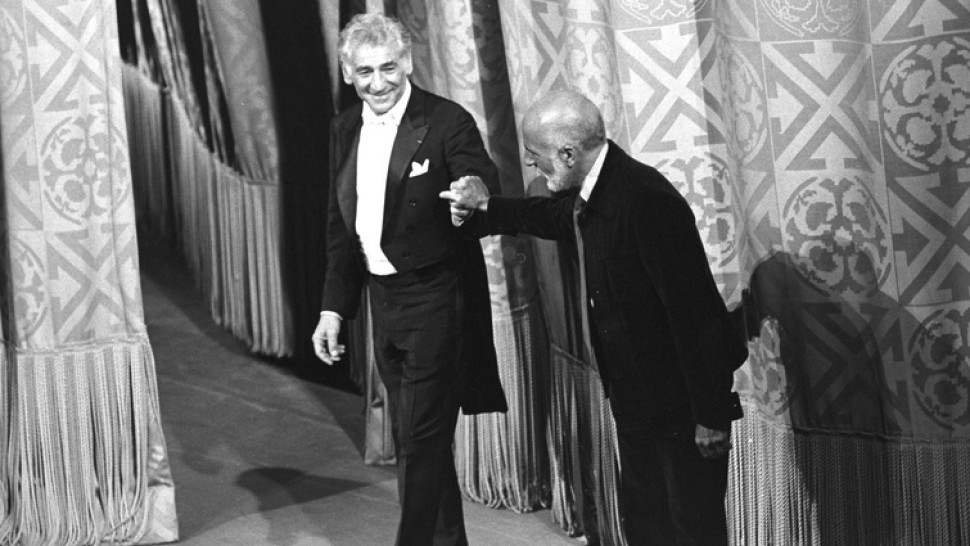
Bernstein and Robbins take a bow after DybbukMartha Swope
It’s strange that working together on the ballet Dybbuk should have been so difficult for Robbins and Bernstein. Turning S. Ansky’s famous Yiddish play about demonic possession and the persistence of love into a ballet with music by Bernstein had long been on Robbins’ mind. The subject resonated with their heritage as the offspring of Russian-Jewish immigrants. In 1954, Lincoln Kirstein had hurt Robbins’ feelings by turning down the idea of Dybbuk for New York City Ballet. Perhaps that’s why, when the project was finally given the go-ahead 20 years later, Robbins accommodated to the company’s image as the repository for George Balanchine’s great, plotless works—eliminating details of the story in an effort to convey its essence through dancing. He complained that Bernstein’s score was too dramatic. After the premiere, he pruned the ballet further, re-titling it Dybbuk Variations, then restored some of what he’d pruned, and finally in 1980 presented just the men’s choreography as Suite of Dances. At Dybbuk’s 1974 premiere, Helgi Tomasson played Chanon, the scholar deprived of his promised bride, who returned as a dybbuk. It was Tomasson, as artistic director of the San Francisco Ballet, who undertook to restore the original choreography in 2005. The revival reminds us that the score is one of Bernstein’s greatest, displaying his genius for catching the dramatic moment and revealing in full measure his originality in terms of melody, rhythm, and orchestration.
Bernstein had died by the time Peter Martins started pestering Robbins in 1994 to do West Side Story as “a choral ballet,” hoping that the story might entice more young people to the New York City Ballet’s performances. It is perhaps significant that Robbins, in his 70s, having lost many of his contemporaries, didn’t trace the story to its ending, with the killing of Tony, its hero. Instead, after the demise of Riff and Bernardo in fights, the cast assembles onstage to sing (!) and dance Bernstein’s beautiful, hopeful anthem “Somewhere,” as a statement the composer would surely have seconded—that tolerating diversity might lead to a better world.
For the latest news and features about CLASSICAL MUSIC, OPERA and DANCE follow our NEW Classical Arts social channels!
Jack Wetherall (The Elephant Man, Queer as Folk) has joined the cast of Roundabout Theatre Company’s Skintight, the world-premiere play by Significant Other and Bad Jews playwright Joshua Harmon.
Wetherall replaces John Noble, who departed the production due to scheduling conflicts, according to Roundabout.
Tony Award winner Idina Menzel (Wicked, If/Then) stars in the play about a divorcée with a 20-year-old son, who discovers that her famous father may be in a relationship with a 20-year-old gay adult film actor. Wetherall will play Menzel’s father.
When it comes to tackling Lerner and Loewe’s My Fair Lady (currently running at Lincoln Center Theater’s Vivian Beaumont), star Lauren Ambrose has a plethora of source material available for consultation. “There’s the original myth, George Bernard Shaw’s interpretation of that myth [as] a play, then there’s the movie, then there’s the musical, then there’s a movie of the musical…” she pauses. “It’s like excavating, looking for our truth and our version in this moment.”
In absorbing the many iterations of the story and portrayals of Eliza Doolittle, Ambrose’s most informative source has been herself. “I think of my own growing up quite a bit in this play,” she says. “I used to be really wild and dissatisfied and angry and had a journey toward becoming a lady; I think that’s with anybody coming into their own power.”
Combining her own calm power with cleverness and cunning inspired by Wendy Hiller (who played Eliza in the 1938 movie), Ambrose creates a strong, ambitious, “superhero” of a woman. Her Eliza is one of agency, a poor flower seller who decides to defy her station by taking linguistics professor Henry Higgins up on his bet that he can train a ragamuffin like her to pass as a high-society Londoner. “It drives the whole plot that she does this courageous move by showing up in this world that is not her own. I find it very moving and very brave.”
Ambrose, too, shows up in a world not entirely her own. An accomplished stage performer, My Fair Lady marks her first Broadway musical.
“She is one of the best actresses I know,” says director Bartlett Sher, who worked with Ambrose in 2006’s Awake and Sing!. While Eliza is known as one of the most vocally demanding roles in the canon, Sher needed someone who—through the yelling and the belting and the pinging, all in two accents—could maintain the inward spirit of Eliza.
“I’m an actor before I’m anything else,” she says. Still, Ambrose isn’t trying to dis-appear into the part. “It reminds me of this hairdresser: Some people would come in and say, ‘Here is a picture of Brad Pitt and I want to look like Brad Pitt.’ She’d say, ‘You’re going to look like you with shorter hair,’” Ambrose recalls. “Ultimately, it’s me with shorter hair. It’s me playing Eliza Doolittle.”
As Eliza discovers herself and her poten-tial, so does Ambrose. “I hope to continue to learn to hold myself as an equal in this world,” she says. “Higgins and Eliza need to achieve an equality, but part of that is Eliza holding herself in that space—that’s something I feel like I’m learning every day.”
The Signature Theatre’s production of Dominique Morisseau’s play Paradise Blue began performances Off-Broadway April 24 ahead of a May 14 opening night. Tony winner Ruben Santiago-Hudson, who directed the world premiere at the Williamstown Theater Festival in 2015, helms a company made up of Francois Battiste (Head of Passes), Kristolyn Lloyd (Dear Evan Hansen), J. Alphonse Nicholson (Luke Cage), and Keith Randolph Smith (Malcolm X, Jitney).
Flip through photos of the show below:
First Look at Paradise Blue Off-Broadway With Dear Evan Hansen’s Kristolyn Lloyd
Set in Detroit’s gentrifying Blackbottom neighborhood in 1949, the new play looks at the changes a community endures to find its resilience. The story follows Blue, a troubled trumpeter and the owner of Paradise Club, who is torn between remaining in Blackbottom with his loyal lover Pumpkin and leaving behind a traumatic past.
Paradise Blue is the first play of Morisseau’s Signature Residency, which will include three productions over the course of five years.
The creative team includes Neil Patel (scenic design), Clint Ramos (costume design), Rui Rita (lighting design), Darron L West (sound design), Thomas Schall (fight direction), Kenny Rampton (original music), and Bill Sims, Jr. (music director). Laura Wilson is the production stage manager. Casting is by Caparelliotis Casting.
The nominations for the 2018 Tony Awards will be announced May 1 at 8:30 AM by Hamilton Tony winner Leslie Odom Jr. and current Waitress star Katharine McPhee.
Check back here for updates as nominations are revealed.
The 72nd annual ceremony will be broadcast by CBS from Radio City Music Hall June 10. Sara Bareilles and Josh Groban will co-host.